Is 3D Printing Toxic? How 3D Printer Fumes Affect Your Health
Your 3D printer heats plastic to 200°C+ in your room. Should you be worried? Here's what the science actually says.
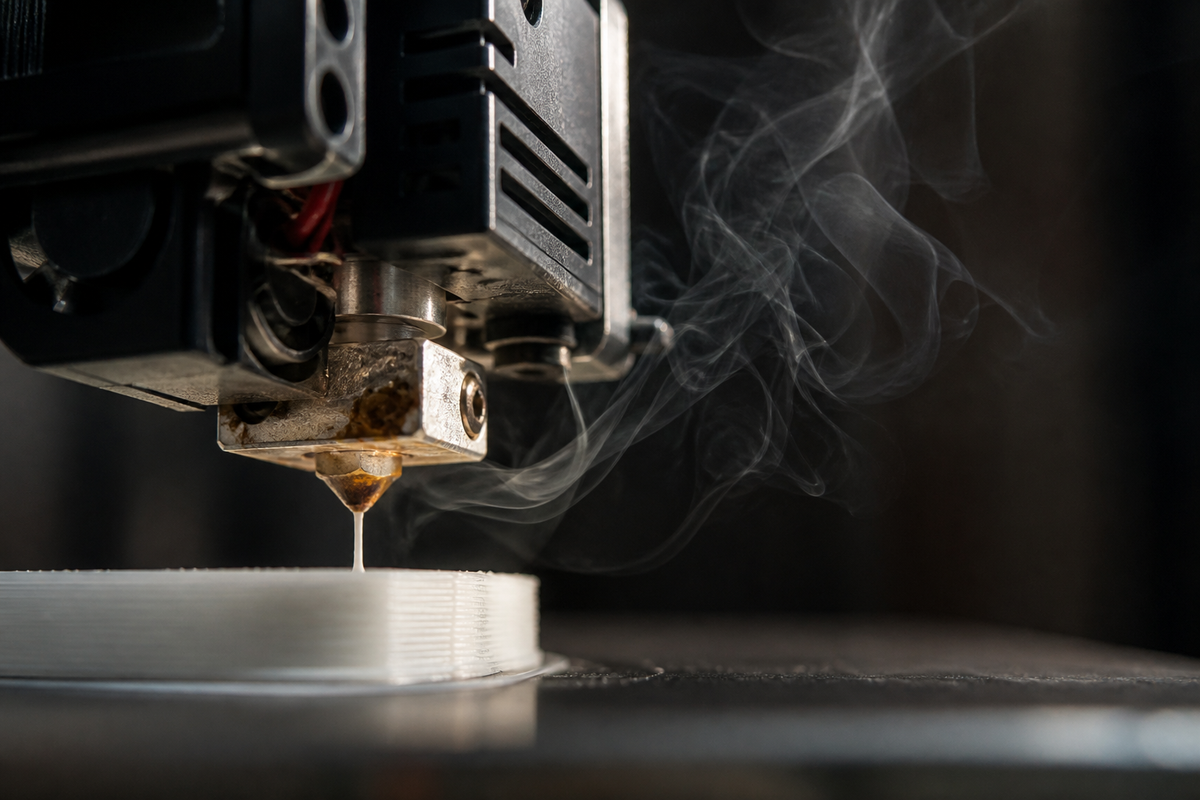
Often when a 3D printer is running, you'll smell a warm, plasticky smell. But that does raise the question: is 3D printing toxic, and are 3D printer fumes toxic enough to actually be concerned about? So basically, it comes down to two things: what you're printing, and how well ventilated your space is. The risk of PLA in a ventilated room is very low. However, fumes and particles from materials such as ABS can be more worrying, especially in a small or poorly ventilated space. This guide covers what 3D printing fumes are, the 3D printer health risks they pose, and how to improve the safety of your setup.
Understanding 3D Printer Fumes: UFPs vs VOCs
When a 3D printer melts plastic by heating it, it releases two very different things into the air: UFPs and 3D printer VOC emissions. These distinct pollutants are emitted together but controlled differently.
Ultrafine Particles (UFPs) are microscopic bits of solid plastic, ranging from 1 to 100 nanometres. They're small enough to slip through your body's natural filters and go much deeper into your respiratory system. All types of filament create UFPs to a certain degree, including "safe" filaments such as PLA. The fix is a HEPA filter, which is built to trap particles at this scale.
Volatile Organic Compounds (VOCs) are where things get problematic. VOCs are gases released when plastics and additives are heated. They vary widely by material and can include irritants or, in some cases, suspected carcinogens. Activated carbon filters absorb them.
Research from the EPA and NIOSH has specifically studied desktop 3D printer emissions and confirmed both UFPs and VOCs are released during normal operation. This is exactly why "Do 3D printers need ventilation?" is such a common question and why a single filter type usually isn't enough. You need both.
How Toxic Is Each 3D Printing Material?
To fully answer is 3D printing toxic, lets break it down material by material.
Is PLA Toxic?
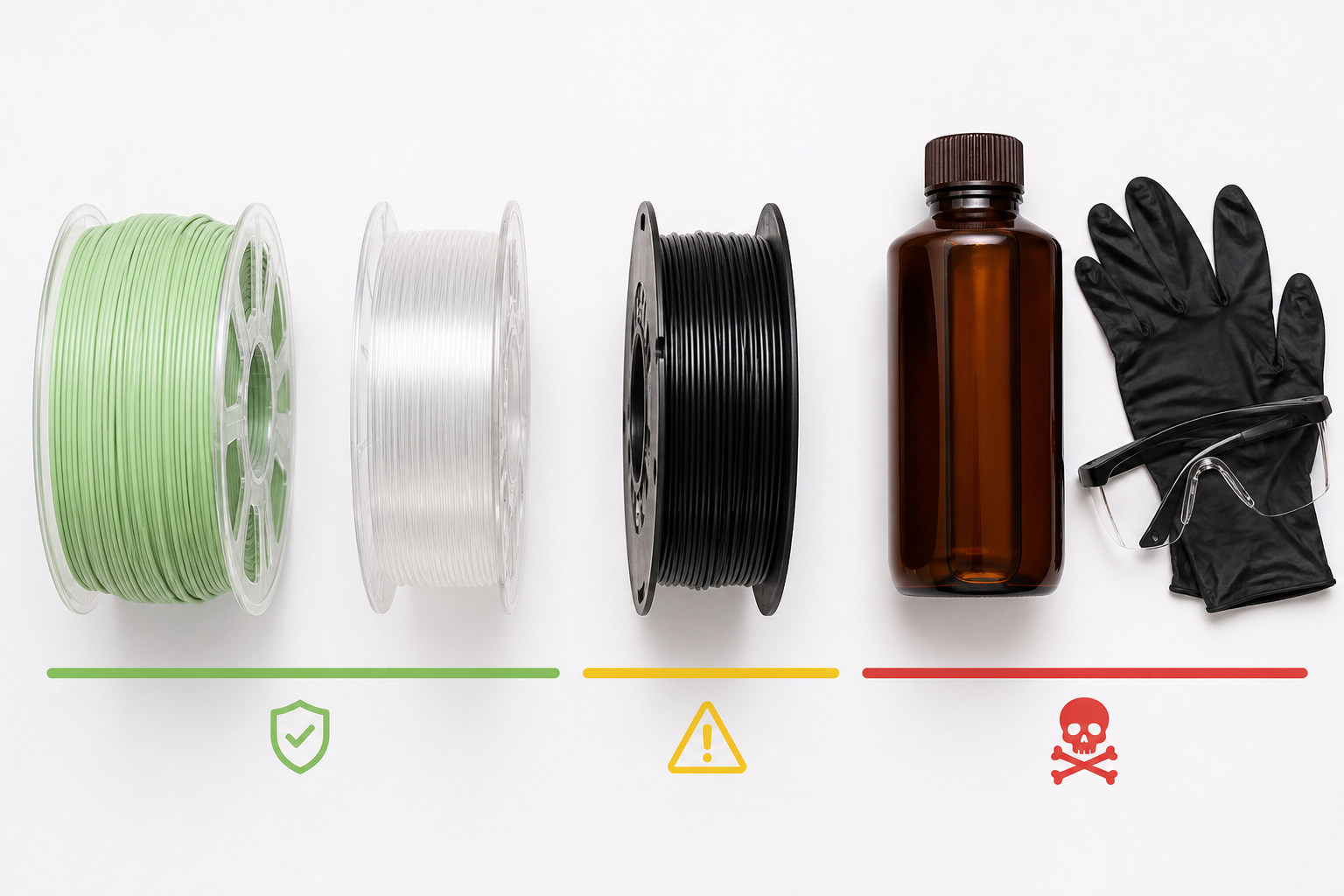
PLA is one of the safest 3D printing materials and a good example of non-toxic 3D printer filament. It's made from plant-based sources like corn starch, and it releases very low levels of VOCs compared to other filaments, with a mild smell some people compare to waffles or sugar. But it still produces UFPs. PLA is safe to use indoors with some basic ventilation such as an open window or fan.
Is PETG Toxic?
PETG is low risk, contains no styrene, prints with minimal odor, and has a low VOC output, making it generally fine for indoor use without a special setup, provided basic room ventilation is sufficient.
Is TPU Filament Toxic?
TPU, the flexible filament used for phone cases and gaskets, is another low-toxicity choice that produces no nasty fumes when printing, making it safe to use with standard ventilation just like PETG and PLA.
Is ABS Toxic?
ABS is where the risk profile changes because it releases styrene during printing—a compound classified as a possible carcinogen with prolonged exposure. For this reason, ABS should not be printed casually in an open room; it requires an enclosure, an activated carbon filter, and ideally a separate, well-ventilated space, and it should never be used in a bedroom or anywhere you spend extended time nearby.
Is Resin Toxic?
Resin is the most hazardous material on this list: uncured resin is a skin and respiratory irritant where reactions can occur with even small amounts of exposure. You should always use gloves and safety glasses when handling resin and always print resin in a dedicated workspace with active ventilation rather than in spaces where you eat, sleep, or spend unprotected time.
Here is a quick summary:
| Material | Risk Level | Ventilation Needed |
|---|---|---|
| PLA | Low | Basic room airflow (open window/fan) |
| PETG | Low | Basic room airflow |
| TPU | Low | Basic room airflow |
| ABS | Moderate to High | Enclosure, carbon filter, separate room |
| Resin | High | Dedicated space, gloves, glasses, active exhaust |
Does 3D Printing Cause Cancer?
That's a fair question, especially when you learn that ABS releases styrene, which the International Agency for Research on Cancer (IARC) classifies as Group 2B (possibly carcinogenic to humans).
However, that rating is based on industrial-level exposure, such as factory workers handling styrene over many years.
To date, there are no documented cases of cancer linked to hobby-level 3D printing. However, research on long-term hobby exposure is limited. That is why exposure should still be minimised. Avoid printing ABS for hours each day in an unventilated room. Use an enclosure, effective filtration, and good ventilation when working with ABS.
Bottom line: there is no evidence that casual 3D printing causes cancer. Still, reducing exposure to ABS fumes is a sensible precaution.
Is 3D Printing Safe Around Pets and Kids?
If there are kids or pets in the house, a few extra precautions are worth taking to manage 3D printer health risks.
- Kids: For kids, the risk is twofold: the physical danger of a hot nozzle, often 200°C or higher, and fume exposure. Kids breathe faster than adults, and their lungs are still developing, which makes them more sensitive to airborne particles and VOCs. An enclosed printer helps address both risks at once, and sticking to PLA keeps fume exposure as low as possible.
- Dogs/Cats: For dogs and cats, the concern is mainly respiratory. Pets have more sensitive lungs and airways than humans, so a smell that seems faint to you can be a much stronger irritant to them. PLA with basic ventilation is generally fine for pets, but ABS should not be run in the same room as your animals.
- Birds: Birds are especially vulnerable. Their respiratory systems are extremely sensitive, similar to how fumes from a non-stick pan can be fatal to them. Because of this, a 3D printer, especially one running ABS, should be kept in a separate room entirely.
A simple rule of thumb is: if you can smell your printer strongly, then your pet is probably being affected more than you are.
How to Reduce 3D Printing Health Risks
Reducing your risk comes down to a few habits, and none of them require expensive equipment. 3D printer ventilation is the simplest fix. A fan pointed out an open window will draw fumes away from your space rather than allowing them to settle. It costs nothing and works for most setups at home. Never print in a totally enclosed room even with PLA. Enclosed 3D printer fumes, left with nowhere to go, build up over time, and a closed door isn't enough on its own.
But if you need stronger protection for materials, there's enclosure and filtration. The ultrafine particles, the microscopic plastic bits shed by every filament, are caught by a HEPA filter. An activated carbon filter soaks up VOC gases, the chemical fumes that come from heated plastic. You will need both types of filters because each targets a different pollutant. Both are useless alone. For ABS and resin, where you have higher emissions and higher health stakes, you need a proper resin printer enclosure and carbon filtration.
Sometimes the safest materials are the easiest changes you can make. PLA and PETG are fine for home use with little setup, just basic airflow. Avoid ABS unless you are prepared to commit to proper ventilation and filtration. If you're printing occasionally or in a shared living space, sticking to non-toxic 3D printer filament removes most of the guesswork and keeps setup straightforward.
It is helpful to think about materials, as well as placement. A printer in a corner of an open living area with airflow is safer than one crammed in a small, closed bedroom, filament type notwithstanding. Where you place your printer can matter as much as the filters you use.
Quick checklist of safety:
- PLA/PETG → window open, done
- ABS → enclosed 3D printer fumes need carbon filter + separate room
- Resin → gloves + glasses + dedicated space + active exhaust
Is 3D Printing Bad for the Environment?
Besides the health question of is 3D printing toxic, 3D printing also has an environmental footprint. PLA is often touted as biodegradable, but only if it is processed in an industrial composter with closely monitored heat and moisture levels that cannot be achieved in the average home composter. In a normal landfill, PLA degrades at the same slow rate as other plastics. The label "eco-friendly" does not always hold up to conditions outside of specific ones.
Failed prints add up fast, especially if you are still learning the settings on your printer. Every failed attempt means plastic waste. If you do a lot of finishing work, consider the 3D printing microplastics released into the air and onto surrounding surfaces via sanding and post-processing of prints.
The upside is that printing custom or on-demand parts at home reduces shipping and packaging waste for ordering manufactured goods. That tradeoff can make a big difference in your footprint for small one-off items compared to buying new ones.
FAQs
Are 3D printers bad for your health?
Depends on the material. Low risk for PLA. ABS and resin need special care such as ventilation and filtration.
Is it safe to 3D print indoors?
Yes for PLA and PETG, as long as there is basic airflow. ABS requires an enclosure. Resin requires a special, ventilated area.
Is it safe to drink from a PLA cup?
PLA itself is non-toxic and food-contact safe in raw form, but the layer lines from FDM printing trap bacteria. Not recommended for repeated use without a food-safe epoxy coating.
Is it safe for kids to play with 3D printed toys?
PLA toys are usually safe. Sand down sharp edges and avoid small detachable parts when playing with younger children.
Comments ()