Caltech Uses 3D Printing to Build a Better, Cobalt-Free Battery
Caltech researchers used 3D printing to build a cobalt-free lithium-ion battery cathode with a complex internal architecture that improves ion transport and mechanical resilience.
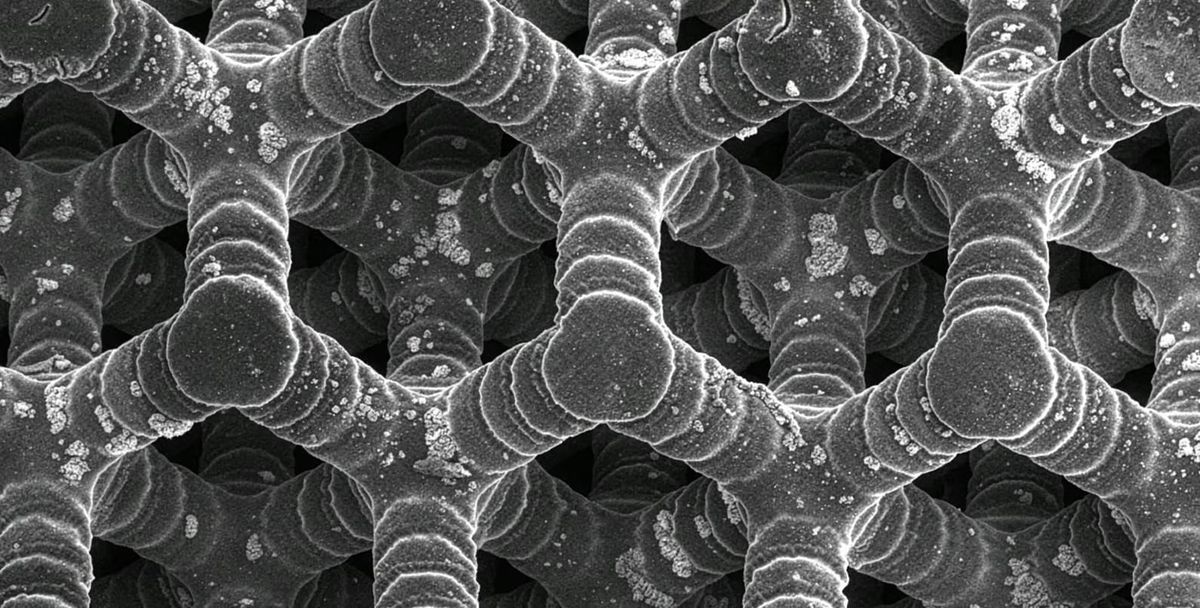
Researchers at the California Institute of Technology have demonstrated a new approach to lithium-ion battery design: instead of flat, layered electrodes, they 3D-printed cathodes with complex internal architectures that improve how ions move through the battery.
The work, published in ACS Energy Letters in June 2026, was led by Professor Julia R. Greer and graduate student Yingjin Wang.
The Problem with Current Batteries
Most lithium-ion batteries use flat, planar electrode designs. These work well enough — they're cheap and simple to manufacture — but they limit how efficiently lithium ions can travel through the battery. They also typically rely on cobalt, a material that's expensive, difficult to recycle, and often sourced under questionable labor conditions.
The 3D-Printed Solution
The Caltech team built cathodes using lithium iron phosphate (LFP) combined with a carbon matrix — completely eliminating cobalt from the equation. But the real innovation is the structure: instead of flat layers, the electrodes have a carefully designed 3D architecture with interconnected pores and high surface-to-volume ratios.
The manufacturing method is called Hydrogel Infusion Additive Manufacturing (HIAM):
- A blank scaffold is 3D-printed using a DLP (digital light processing) printer
- The scaffold is converted from organogel to hydrogel
- The hydrogel absorbs lithium, iron, and phosphate precursors from a solution
- Calcination at 800°C transforms the structure into the final LFP/carbon electrode
The result: feature sizes down to 18 micrometers, with a specific capacity of 160 mAh/g at C/10 — competitive with conventional manufacturing approaches.
Why the Architecture Matters
The team tested three different internal geometries — tilted cubes, honeycombs, and triply periodic minimal surface (TPMS) structures — to understand how shape affects electrochemical performance. Their modeling identified two key bottlenecks: lithium-ion transport through the electrolyte, and solid-state lithium diffusion within the electrode material itself.
By adding a third dimension and controlling the internal geometry, the team created more efficient pathways for ions to travel — something that's physically impossible with flat electrode designs.
What's Next
The team's next goal is to design a complementary 3D-architected LFP anode to create a battery with fully 3D-printed electrodes on both sides. If successful, this would produce a battery that's both energy-dense and power-dense — without any cobalt.
Professor Greer notes that "LFP by itself is not a new material, but using additive manufacturing to create an architected electrode that doesn't contain cobalt is a new thing."
Reality Check
This is still research-stage work. There's no indication these batteries are ready for mass production, and significant challenges remain before manufacturers could adopt an entirely new electrode architecture. But it demonstrates how 3D printing can solve problems in fields far beyond plastic prototypes — including energy storage, a market worth hundreds of billions of dollars.
Research Details:
- Institution: California Institute of Technology (Caltech), Greer Lab
- Lead Researchers: Julia R. Greer, Yingjin Wang
- Published: ACS Energy Letters, June 2026
- Method: Hydrogel Infusion Additive Manufacturing (HIAM)
- Material: Lithium iron phosphate (LFP) / carbon composite
- Key Result: Cobalt-free cathode with 3D architecture, 160 mAh/g at C/10
- Feature Size: Down to 18 μm
Source: Caltech News, 3DPrint.com, ACS Energy Letters

Comments ()